Our Blog
Useful articles and news

How to turn an idea into your own business: a free training programme
A free training and support programme for those wishing to set up their own business is set to begin in October. 📚 100 hours of training — entirely online. The programme is aimed at young people aged 18 to 35 who are not in work, are looking for work or are unemployed, as well as young participants in the GOL programme who meet the necessary requirements. 💡 The programme covers: • business ideas and business models; • market and customer analysis; • marketing and sales; • costs, revenue and financial sustainability; • drawing up a business plan; • preparing to apply for potential support to set up your own business, including Resto al Sud 2.0. 👥 Training format: 🔹 60 hours of group training 🔹 40 hours of individual support 👩🏫 Tutor — Maryna Sydorova. She has experience in business, exports, project management, career guidance and teaching. 📩 A group is currently being formed for October. If you’re interested, please message me directly to check whether you meet the requirements and to receive further details. 📲 WhatsApp: 327 697 4060
Almost 2.6 million foreign nationals work in Italy – that is more than 10 per cent of the total workforce
The role of foreign workers in Italy continues to grow. In 2025, there were almost 2.6 million foreign nationals working in the country — accounting for 10.7 per cent of the total workforce. Moreover, it was foreign workers who accounted for a significant proportion of the growth in employment: the number of non-EU nationals in employment rose by 3.6 per cent, EU nationals by 1.2 per cent, and Italians by 0.5 per cent. 👷 Where do migrants most commonly work? 🔹 Other collective and personal services — foreign nationals account for 29.8 per cent of workers in this sector. 🔹 Agriculture — 21.5 per cent of workers are foreign nationals. 🔹 Hotels and restaurants — 19.2 per cent. 🔹 Construction — 17.9 per cent. At the same time, the proportion of foreign workers is significantly lower in the financial and insurance sectors — 1.6 per cent, in information and communication services — 3.1 per cent, and in public administration — just 0.3 per cent. 📈 Italy is increasingly in need of foreign workers In 2025, Italian companies planned to hire over 1.3 million foreign workers — a record figure and around 23 per cent of all planned hires. At the same time, in roughly half of all cases, employers found it difficult to find suitable candidates. In other words, the Italian economy needs foreign workers not just today — demand for them continues to grow. However, there remains a gap in unemployment rates between foreign nationals and Italians. In 2025, it stood at 9.6 per cent amongst non-EU nationals, 7.8 per cent amongst EU nationals and 5.8 per cent amongst Italians. The gap is particularly pronounced among women: the employment rate for women from non-EU countries stood at just 45.7 per cent, compared with 76 per cent for men. For Ukrainians, this means that the Italian labour market is gradually opening up more opportunities, not only in traditional sectors such as care work, cleaning, agriculture, catering and construction. Professional skills, qualifications and services that migrants can offer independently are becoming increasingly important. 💙💛 It is therefore important not only to look for work, but also to showcase one’s professional skills. It is worth noting that on the UA Service HUB platform, Ukrainian specialists in Italy can showcase their services, experience and portfolios, and find clients both in their own city and beyond.
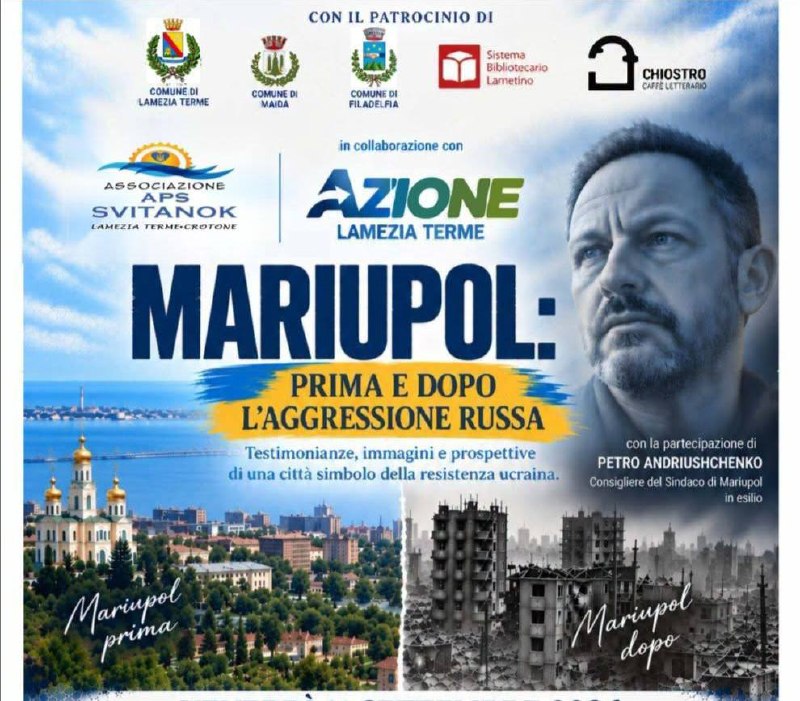
‘Mariupol before and after the Russian aggression’: Ukrainian prisoners of war to be discussed in Italy
On 11 September, the Italian town of Lamezia Terme will host a public event entitled ‘Mariupol before and after the Russian aggression’, dedicated to the plight of Ukrainians who have found themselves under Russian occupation and in captivity. The discussion will be attended by the mayors of Lamezia Terme, Philadelphia and Maida, as well as representatives of Italian and Ukrainian associations and political groups at various levels. A live link with Petro Andriushchenko, a former adviser to the mayor of Mariupol, is also planned. During the meeting, discussions will focus on the lives of Ukrainians under occupation, civilian and military hostages, as well as mechanisms for securing the release of people from Russian captivity and unlawful detention. Particular attention will be paid to the issue of guardianship for civilian hostages – what it entails, how it works, and why international attention focused on specific individuals can be an important tool for exerting pressure on Russia. They will also discuss the need to strengthen information security, political and economic support for Ukraine, and the preservation of social programmes for Ukrainians who have been forced to leave their homes due to the war. 🖼️ Two exhibitions — about those whose voices have been silenced Two themed exhibitions will be presented as part of the event: ▫️ ‘Civilian Hostages’ – about Ukrainians held captive by Russia; ▫️ ‘Olenivka’ — about Ukrainian prisoners of war who were held in a penal colony in occupied Olenivka. The organisers aim not only to shed light on the crimes of Russian aggression, but also to encourage more people to support Ukrainian civilian hostages. Among the main aims of the event are to find individuals and organisations willing to take at least one civilian hostage under their care, to draw attention to their stories, and to help spread information about the unlawful detention of Ukrainians. There will also be a separate discussion on programmes for Ukrainian children, which help them to feel safe and cared for again, and to remain children despite the war.
Against migration and in favour of closer ties with Russia: support for a new far-right party is growing in Italy
The recently formed far-right party Futuro Nazionale (‘National Future’) in Italy continues to climb the polls and now ranks fourth among the country’s political parties. This is reported by La Repubblica, citing a SWG poll. In the latest poll on voter preferences, the party – founded in June 2026 by General Roberto Vannacci – has set a new popularity record, approaching the 8 per cent mark. Prime Minister Giorgia Meloni’s party, ‘Brothers of Italy’ (Fratelli d’Italia), remains in first place with 26.8 per cent. The Democratic Party is in second place with 20.6 per cent, whilst the ‘Five Star Movement’ (Movimento 5 Stelle) is in third with 12.5 per cent. Among centre-right parties, Forza Italia has 6.9 per cent, whilst Matteo Salvini’s ‘League’ has 5.7 per cent. The ‘Alliance of Greens and the Left’ received 6.8 per cent. What does Roberto Vannacci stand for? The Futuro Nazionale programme calls for a significant restriction on migration and a policy of so-called ‘remigration’. Vannacci proposes limiting the proportion of new migrants to 4 per cent, repealing the Decreto Flussi, stepping up the deportation of illegal migrants and those who commit crimes, and making it more difficult to obtain Italian citizenship. The party also advocates reducing the powers of the EU and strengthening Italy’s national sovereignty — particularly in matters of the economy, defence, energy and agriculture. Vannacci calls for a halt to further political integration of the European Union and for a reduction in European bureaucracy. On social issues, the party takes a conservative stance: it opposes the expansion of LGBTQ+ rights and the principles of ius soli and ius scholae, and advocates a traditional model of child-rearing and measures to support the birth rate. Furthermore, Vannacci opposes the continuation of military and financial support for Ukraine, and advocates the restoration of economic ties with Russia. It is worth noting that the far right is strengthening its position not only in Italy. For instance, on 6 September, in the regional elections in Saxony-Anhalt, Germany, the ‘Alternative for Germany’ (AfD) party secured a historic victory, winning 43.8 per cent of the vote. Consequently, the rise of far-right and nationalist forces is becoming a noticeable trend in several European countries at once. It should be noted that parliamentary elections in Italy are due to take place in 2027, and Vannacci’s rapid rise in popularity is already posing an additional challenge for Giorgia Meloni and her centre-right coalition.

Artificial intelligence will help Germany identify Russian saboteurs
Following an attempted attack involving a drone carrying explosives at Leipzig/Halle Airport, Germany plans to significantly step up its defences against Russian sabotage, espionage, cyberattacks and other hybrid threats. German Interior Minister Alexander Dobrindt has presented a comprehensive security plan, which includes: 🔹 Artificial intelligence to detect spies and potential terrorists. The AI is to analyse CCTV footage, automatically recognise weapons and suspicious behaviour, and help identify individuals suspected of planning attacks or engaging in espionage. 🔹 Enhanced protection against drones. The German Federal Police will expand its mobile units, equipped with helicopters and specialised vehicles. They will be stationed in nine strategic cities — Frankfurt, Munich, Hamburg, Berlin, Stuttgart, Düsseldorf, Leipzig, Hanover and Cologne. 🔹 Protection of critical infrastructure. Water utilities, energy companies and defence enterprises may be granted greater powers to respond to drones independently, without waiting for state forces to arrive. 🔹 Biometrics and CCTV. There are plans to make wider use of facial recognition technology, particularly at railway stations. 🔹 National Cyberdome. Germany plans to create a network of digital sensors designed to detect and block cyberattack attempts. “Russia’s hybrid attacks are a daily reality,” Dobrindt stated, emphasising that such threats could intensify. It should be recalled that on 1 September, Germany officially accused Russia of a hybrid attack on Leipzig/Halle Airport and announced appropriate measures.
Top 10 countries by number of Ukrainians with temporary protection
In the countries of the European Union, around 4.38 million people who have fled Ukraine due to the war are currently under temporary protection. This is according to data from the European Commission. The top 10 countries by number of Ukrainians under temporary protection are as follows: 🥇 🇩🇪 Germany — 1,283,000 people 🥈 🇵🇱 Poland — 967,000 🥉 🇪🇸 Spain — 267,000 4️⃣ 🇨🇿 the Czech Republic — around 390,000 5️⃣ 🇷🇴 Romania — over 200,000 6️⃣ 🇫🇷 France — around 140,000 7️⃣ 🇳🇱 The Netherlands — over 120,000 8️⃣ 🇮🇪 Ireland — around 100,000 9️⃣ 🇸🇰 Slovakia — around 100,000 🔟 🇦🇹 Austria — around 90,000 At the same time, the highest number of Ukrainians per capita is not found in the largest EU countries. Slovakia, Poland and the Czech Republic lead the way in terms of the number of recipients of temporary protection per 1,000 inhabitants. 🇮🇹 And what about Italy? It should be noted that Italy is not in the top 10 in terms of the absolute number of people under temporary protection. Over 170,000 Ukrainians have arrived in Italy since the start of the full-scale war — this is the latest official figure for the total number of arrivals provided by the Italian authorities for the period up to June 2023. According to Eurostat data, 51,105 people had temporary protection status in Italy as at 30 June 2026. In other words, around 170,000 Ukrainians arrived in Italy, and around 51,000 remained registered under the temporary protection scheme as of mid-2026. At the same time, in May 2026, Italy recorded one of the largest increases in the EU — the number of people receiving protection rose by 6,250, or 15.3 per cent, in a single month. 🌎 And what about outside Europe? 🇨🇦 Canada also remains a key destination for Ukrainians. Rather than the European temporary protection scheme, special immigration measures introduced following the outbreak of full-scale war are in place here, notably the CUAET programme. In 2026, Canada continues to allow some Ukrainians who arrived under these programmes to renew their work permits. 🇺🇸 The US is accepting Ukrainians under several special schemes. In particular, Temporary Protected Status (TPS) for Ukraine has been extended until 19 October 2026. In early 2025, USCIS reported that around 103,700 Ukrainians were eligible to re-register under TPS. Separately, thousands of Ukrainians are in the US under the Uniting for Ukraine (U4U) humanitarian programme.
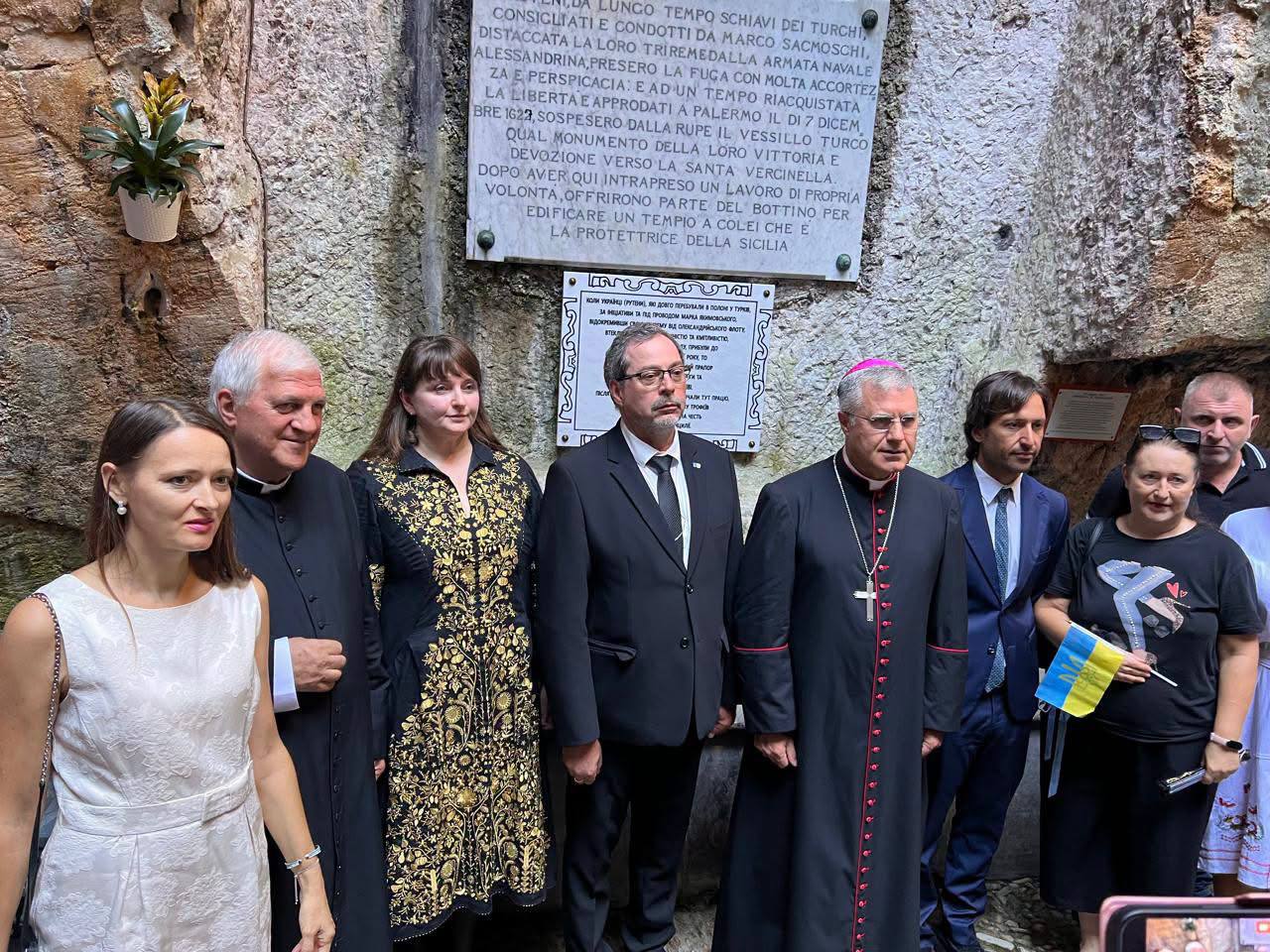
A commemorative plaque in Ukrainian honouring the 17th-century Cossacks has been unveiled in Palermo
A commemorative plaque in Ukrainian has been unveiled in Palermo in honour of the Ukrainian Cossacks who, almost 400 years ago, contributed to the construction of the Sanctuary of Saint Rosalia on Mount Pellegrino. This was reported by the Ministry of Foreign Affairs of Ukraine. The unveiling ceremony was attended by Andriy Yurash, Ukraine’s Ambassador to the Holy See and the Sovereign Order of Malta; the Archbishop-Metropolitan of Palermo, Primate of Sicily Corrado Lorefice, representatives of the Ukrainian community, local and regional authorities, the clergy and pilgrims. 📜 The history of this shrine has been linked to Ukrainians since 1627. In December 1627, Ukrainian Cossacks led by Mark Yakymovskyi arrived in Palermo. The day before, they had mutinied on a Turkish galley near the island of Lesbos, freed themselves from captivity and rescued around 220 Christian captives, most of whom were Ukrainians. On 7 December, the Cossacks visited the Shrine of Saint Rosalia on Monte Pellegrino. As a token of gratitude for their liberation from many years of captivity, they donated part of the spoils they had captured towards the construction of the church, which was only just beginning at the time. Today, commemorative plaques at the Sanctuary in Latin and Italian serve as a reminder of this story. A new plaque in Ukrainian reproduces the content of the historical inscriptions and also clarifies the date of the event and the name of the Cossack leader in accordance with modern historical research. The unveiling was attended by Andriy Yurash, Ukraine’s Ambassador to the Holy See and the Sovereign Order of Malta, Archbishop-Metropolitan Corrado Lorefice of Palermo, representatives of the Ukrainian community, local and regional authorities, the clergy and pilgrims. This story serves as a reminder of Ukraine’s centuries-old ties with Sicily and the broader European dimension of Ukrainian history. And the story of the Cossacks, who fought for liberation from bondage almost 400 years ago, takes on special symbolic significance today for Ukraine, which continues its struggle for freedom. 📅 On 7 December 2027, to mark the 400th anniversary of the arrival of Ukrainian Cossacks in Palermo, a special Ukrainian pilgrimage to the Sanctuary of Saint Rosalia is planned.
Politicians in France have clashed over military aid to Ukraine
The presidential campaign has effectively kicked off in France, and the war in Ukraine is already becoming one of the key issues in the upcoming election. Two potential frontrunners — Marine Le Pen, leader of the far-right ‘National Rally’, and centre-right politician Édouard Philippe — have exchanged sharp remarks regarding continued support for Ukraine. The dispute was sparked by a statement from Louis Aliot, vice-president of the ‘National Rally’. He stated that, should the party come to power, France should cease military aid to Kyiv. The politician explained his position by citing the difficult economic situation in France and a lack of funds for healthcare, education and other domestic needs. Édouard Philippe sharply criticised this stance. In his view, ceasing aid to Ukraine would effectively play into Russia’s hands and pose an additional threat to the security of Europe and France. “Turning off the tap” for Ukraine would be doing Russia a favour. “Weakening Ukraine is a threat to the security of Europe and France,” said Philippe. Marine Le Pen responded by stating that she was not in favour of prolonging the war, but rather of a diplomatic settlement. She recalled that, right from the start of the full-scale invasion, she had called for an international peace conference. Philippe, for his part, accused Le Pen of being too soft on Russia and stated that, should she come to power, Ukraine could be left without France’s support. 🗳️ The French presidential election will take place in spring 2027. According to current polls, Marine Le Pen has around 35 per cent support and is ahead of Édouard Philippe, who is backed by around 15 per cent of voters. For Ukraine, the outcome of the French elections could be of significant importance, as France remains one of the key EU states in terms of military and political support for Ukraine. Based on material from UNIAN.UA

CRASA APS marks its second anniversary: the association is developing projects for Ukrainians in Italy
The C.R.A.S.A. APS Association (Comunità di rifugiati: attività, sviluppo, arte) is celebrating its second anniversary. During this time, the organisation has carried out a number of social, charitable, cultural and awareness-raising projects for the Ukrainian community in Naples. Among the key initiatives of the past year is the charity calendar ‘Ukrainian Women in Italy’. The association has also organised two charity lunches, during which funds were raised to support Ukraine and passed on to partners and charitable organisations. One of CRASA APS’s most ambitious projects has been the UA Service Hub – an online platform based on the work.crasa.team website for finding Ukrainian professionals and services abroad. The project was developed in-house, and the team is currently continuing to work on its development and on expanding opportunities for Ukrainian professionals. This year, CRASA APS also joined the NAU network — Network Associazioni per Ucraina — which brings together organisations working to support Ukraine and Ukrainians. Psychological support remains a key focus of the association’s work. As part of the MindSpace Forum, participants discussed adaptation, finding one’s place and building a new life in another country. CRASA APS actively participates in cultural and patriotic events aimed at promoting Ukraine in Italy. The association organised a photography exhibition featuring Ukrainian photographers and, on 23 August, held a rally in Naples to mark the 35th anniversary of Ukraine’s independence. Partners, volunteers and representatives of the Ukrainian community are involved in the association’s activities. Among CRASA APS’s media partners is BusinessWoman magazine. “We would like to thank everyone who has stood by us over the past two years. We would like to thank our partners, friends, participants in our events, volunteers and everyone who supports our projects,” the association states, emphasising that it plans to continue developing new projects, partnerships and opportunities for Ukrainians in Italy. Support CRASA APS’s work Anyone wishing to support the association’s work, including its social, charitable and cultural projects, can make a donation. C.R.A.S.A. APS Refugee Community: activities, development, art 📧 apscrasa@gmail.com Beneficiary: CRASA APS Bank: Banca Popolare Etica S.c.p. Branch code: 00009 NAPLES BRANCH IBAN: IT16S0501803400000020000760 Every contribution helps CRASA APS to continue its work for the Ukrainian community and to carry out new projects in Italy.